24 / Fintech
ContractCoin.
The problem
Freelancers, contractors and consultants usually negotiate their rate face to face or over email. Whoever names a number first gives something away. Contractors often end up under market, because they are guessing what the employer will pay, and employers are guessing what the contractor will accept. Neither side has a fair way to find the middle.
Paying across borders added a second cost. Transaction and currency exchange fees can be as high as 20 percent, which comes out of the contractor's pay or the employer's budget. Any fix had to deal with both problems at once. A fairer way to agree on a rate would not help if a fifth of the money then disappeared in transfer.
The approach
I teamed up with Adam Terwilliger, a data scientist, engineer and Bitcoin expert who wrote the negotiation algorithm and designed the backend. I led the product and the design.
- 01
Starting with the business case
Before I drew a screen, I developed the concept from a business case. I wrote down who would pay for it, what the two sides were getting wrong today, and what the app would have to do on day one. Adam and I used that page to decide what the prototype should cover and what to leave out.
- 02
Two flows, one deal
I mapped the contractor and the employer as two lanes of one diagram. The employer invites the contractor to bid. Both negotiate a rate, then set contract dates, a payout schedule and a wallet, and both reach a contract review. Laying the lanes side by side showed where each person waits on the other.
Contractor and employer flows. - 03
Storyboarding the negotiation
The double-blind step was hard to explain in words, so I storyboarded it with hands on phones. The employer enters a job title and generates a secret code. The contractor enters that code, and each side submits an offer. The app then returns a recommended figure, and either person can slide to agree.
Negotiation storyboard. - 04
Wireframes
I wireframed the code and offer steps screen by screen. The code is large and easy to read out or paste into a text message. Offers are typed into one big field with a numeric keypad. Keeping each screen to a single decision made the secrecy of the process easy to follow.
Wireframes for the code and offer steps. - 05
Mockups in a design tool
I built the mockups in a single master file in a design tool, with the screens in rows by task. That let me change the bid screen, the currency picker, the availability calendar and the wallet screens together and keep their patterns the same. It also made the file easy for Adam to scan.
Mockups in the design tool. - 06
Visual design, branding, demo
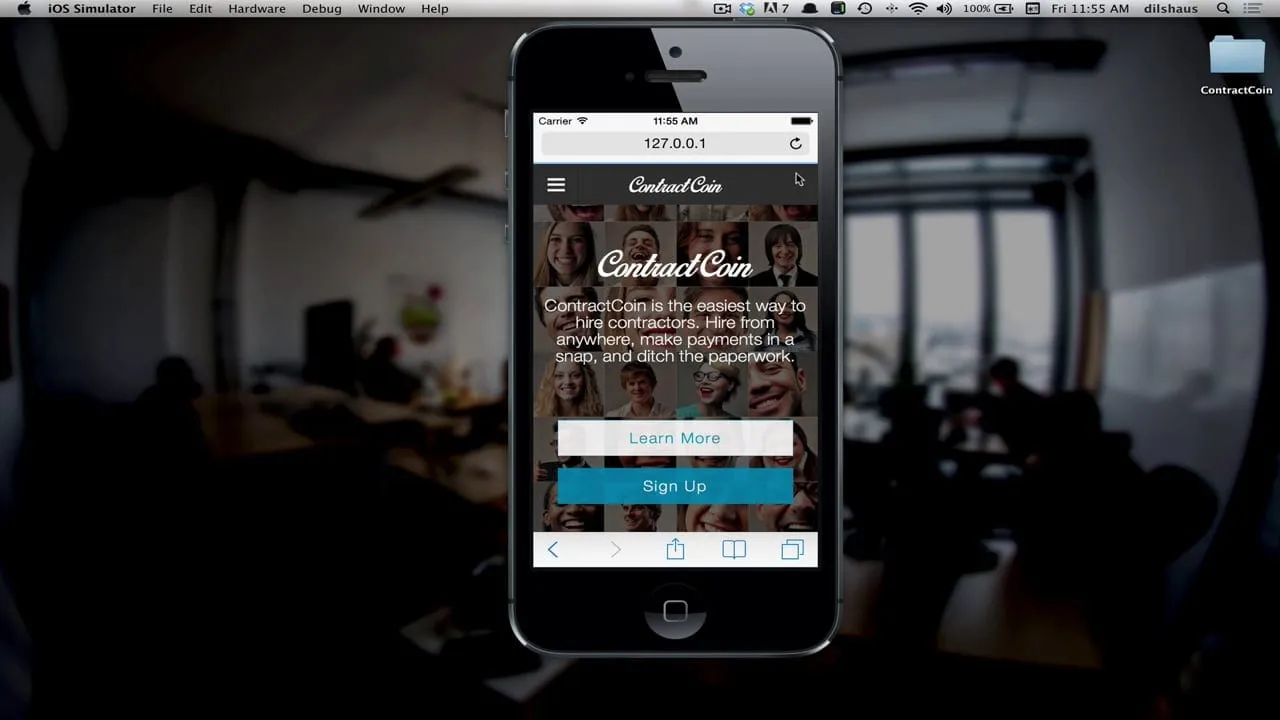
I did the branding and the visual design, using a dark header, a single blue for actions and green for chosen dates. Then I recorded a video demo of the whole product. A video was the best way to show a negotiation that happens in two places at once to people who had never seen one.
Final mockups.
The solution
ContractCoin is a mobile app prototype. An employer invites a contractor to bid for a position. Each side enters a number without seeing the other's, and the app recommends a rate. If both agree, they set contract dates and a payout schedule, add a wallet, and review the contract. Payments run on Bitcoin, so employers can hire from anywhere without the usual transaction and currency exchange fees.
The design idea was to make the secret part tangible. A short code, passed by text message, ties two people to the same negotiation without either one seeing the other's figure. Nobody has to trust the other side's opening move, so the rate can be fair to both and neither side has to bluff.
What I delivered
- Business case for the concept
- Contractor and employer user flows
- Negotiation storyboard
- Wireframes and mockups
- Branding and visual design
- Prototype and video demo
See it working
Value added
For people using it
Contractors could state what they needed without guessing the employer's budget, and employers could do the same. Both sides got a recommended rate to agree to, with no haggling over email.
For the business
The concept paired a fairer negotiation with Bitcoin-based payments, aimed at fees that can be as high as 20 percent. That gave the idea a clear case to present with a working prototype and demo.
For the team
Adam's algorithm and backend had a clear front end to plug into. The flows, storyboard and wireframes gave both of us one shared picture of how a negotiation should run.
The result
Delivered the full concept, from business case to flows, wireframes, mockups, branding, a prototype and a video demo. ContractCoin remains a prototype.
What I took from it
The storyboard with hands on phones did more to get the idea across than any description of the algorithm did. I would storyboard any multi-party interaction first. I would also test the secret code step with real contractors earlier, since the whole product depends on people trusting it.